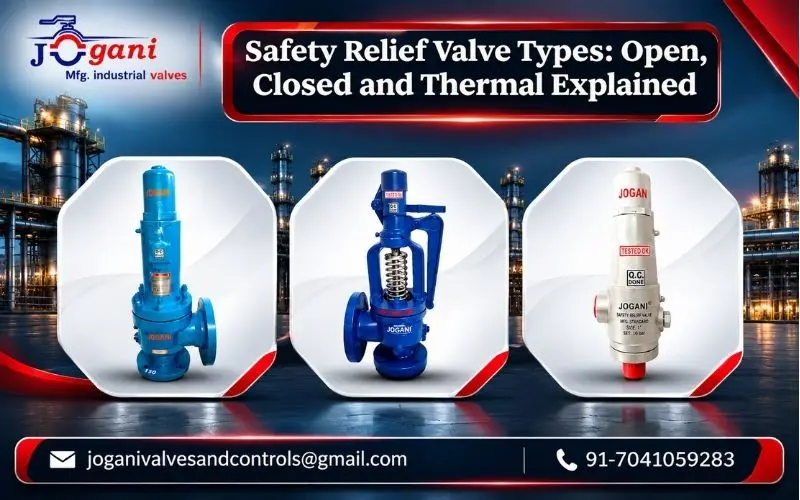
Safety Relief Valve Types: Open, Closed and Thermal Explained
Unexpected pressure rises in boilers, pipelines and process equipment can cause damage or serious hazards. Understanding
Safety Relief Valve Types helps engineers and procurement teams choose protection that suits the process. An incorrect choice may also delay commissioning complicate compliance checks or increase maintenance costs over time.
Open bonnet, closed bonnet and thermal relief are not design categories. Open and closed refer to how a valve’s spring housing’s enclosed or vented. Thermal relief describes an overpressure problem involving heated trapped liquid. This distinction matters when selecting valves for steam systems, chemical plants and industrial pipelines.
How Does a Safety Relief Valve Respond to Excess Pressure?
A relief valve opens at its specified set pressure. Releases fluid to limit overpressure. It reseats when pressure falls sufficiently.
Engineers must also check discharge capacity, allowable overpressure, outlet backpressure and equipment pressure ratings. A valve that fits the pipeline may still lack the capacity needed for the hazard.
Open Bonnet Safety Relief Valve for Steam and Air Systems
An
Open Bonnet Safety Relief Valve has a spring housing vented to the surrounding atmosphere. This arrangement can reduce heat accumulation around the spring in high-temperature services. These valves may suit selected boiler, steam or nonhazardous air applications.
However the exposed spring can collect moisture, dust or corrosive deposits. Process fluid may escape through the bonnet making these valves unsuitable for emissions.
Plant engineers should assess discharge direction, installation location and personnel exposure before approving a bonnet design.
Closed Bonnet Safety Relief Valve for Contained Processes
A
Closed Bonnet Safety Relief Valve encloses the spring within a bonnet that does not vent directly to the atmosphere. In designs the bonnet may communicate internally with the valve outlet. This avoids spring-housing venting.
Engineers often consider closed bonnet construction for chemical, petrochemical and other processes requiring containment. Still “closed” does not automatically mean leak-free or suitable for every fluid.
Check material compatibility, seat tightness, discharge routing and backpressure. Where corrosive media or variable outlet pressure creates problems engineers may need an appropriately designed bellows or balanced valve.
Thermal Relief Valves for Trapped Liquid Expansion
A
Thermal Relief Valve protects liquid-filled equipment when temperature increases inside a section. Imagine a pipeline closed at both ends. Sunlight, heat tracing or a nearby exchanger warms the trapped liquid causing it to expand. Because the liquid has room to expand pressure can rise sharply.
Thermal relief often requires small flows but engineers must evaluate heating, fluid properties and allowable pressure before sizing.
The outlet must discharge to an approved location or recovery system. A thermal relief device is not automatically adequate for fire exposure or other scenarios that require relieving capacity.
Open vs Closed Safety Relief Valve: What Changes?
For buyers comparing bonnet styles the important differences are practical:
- Spring exposure: Open bonnets expose the spring area; closed bonnets enclose it.
- Emission control: Open bonnets can vent process fluid locally; closed designs avoid bonnet venting.
- Operating environment: Open designs need protection against weather and contamination; closed designs still require corrosion-resistant materials.
- Common selection factor: Open bonnets suit some steam services; closed bonnets are generally preferable where containment matters.
Thermal relief addresses pressure buildup from trapped- heating, not bonnet design.
Specifications to Confirm Before Requesting a Quotation
A reliable purchase starts with a process datasheet, not a nominal valve size. Procurement teams should confirm:
- Service medium: Steam, compressed air, water, oil or a specific chemical.
- Pressure details: Normal operating pressure, design pressure, set pressure and expected backpressure.
- Relief duty: Required flow capacity and the reason excess pressure may occur.
- Temperature and materials: body, trim, spring and sealing materials for the fluid.
- Connections and documentation: Inlet/outlet sizes, flange or threaded ends, applicable code requirements and test certificates.
Engineers may choose carbon steel or stainless steel. Actual grades depend on process compatibility and the selected model. In addition buyers should request evidence of set-pressure testing and applicable capacity certification where required.
Choosing a Valve Supplier, in Ahmedabad, Gujarat
Ahmedabad and Gujarat buyers often purchase valves for maintenance shutdowns, upgrades and EPC projects.
Jogani Valves And Controls located in Ahmedabad offers bonnet, closed bonnet and thermal safety valve products as part of its larger industrial valve selection. Buyers may share process details. Ask for confirmation of the right models, materials, connections, pressure settings and required documents.
Conclusion
Understanding Safety Relief Valve Types means distinguishing bonnet construction from thermal‑expansion protection. Open bonnets may suit selected services; closed bonnets support containment‑focused designs; and thermal relief protects trapped liquids from heat‑related pressure rise.
For product specifications or bulk industrial needs contact
Jogani Valves And Controls with your application details and request a quotation.
Frequently Asked Questions