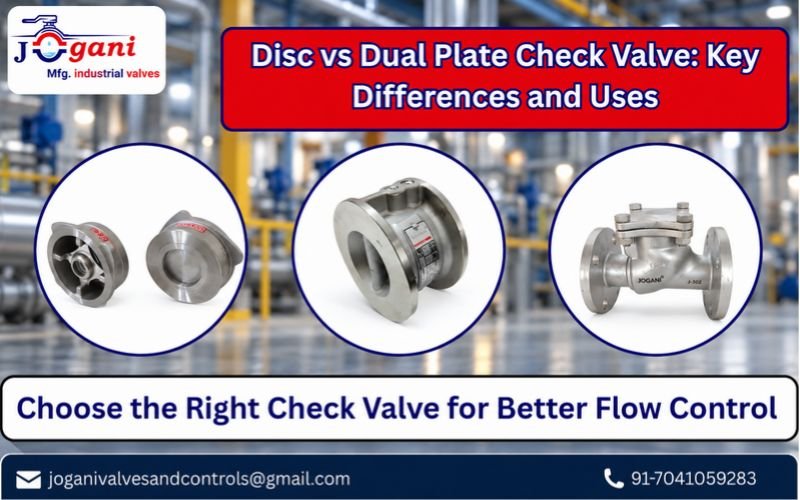
Disc Check Valve vs. Dual Plate Check Valve: Major Differences and Applications
Industrial pipelines need reliable protection against reverse flow. When a pump stops or system pressure changes, fluid can move backwards and affect connected equipment. The wrong
check valve may also create unnecessary pressure loss, noise, or maintenance problems.
Understanding Disc Check Valve vs Dual Plate Check Valve helps engineers and procurement teams select a suitable design. Both valves allow one-way flow, but their internal mechanisms and operating characteristics differ.
For water treatment plants, chemical industries, power stations, and process pipelines, these differences matter. A suitable valve supports safer operation and better system performance.
How a Single Disc and Twin Plates Respond to Flow
A
Disc Check Valve uses a single moving disc to control fluid direction. In a typical spring-loaded design, forward pressure lifts the disc away from its seat. When pressure falls, the spring pushes it back into position.
This Disc Check Valve Working Principle makes the valve suitable for compact installations. The opening pressure depends on the spring design and operating conditions.
A
dual plate check valve works differently. It contains two semicircular plates connected to a central hinge. Forward flow pushes both plates open, while torsion springs help them close as flow decreases.
Therefore, the difference is not simply the number of plates. Their movement, opening resistance, and closing response affect how each valve performs.
Disc Check Valve vs Dual Plate Check Valve: Where They Differ
The Difference Between Disc and Dual Plate Check Valve designs becomes clearer when comparing their operating characteristics.
Internal Design
- Disc Check Valve: Single moving disc.
- Dual Plate Check Valve: Two hinged plates.
Closing Method
- Disc Check Valve: Usually spring-assisted.
- Dual Plate Check Valve: Usually torsion spring-assisted.
Flow Movement
- Disc Check Valve: Disc lifts from its seat.
- Dual Plate Check Valve: Plates rotate around a hinge.
Pressure Drop
- Disc Check Valve: Depends on disc and spring resistance.
- Dual Plate Check Valve: Often lower in suitable comparable designs.
Typical Size Preference
- Disc Check Valve: Compact, smaller pipelines.
- Dual Plate Check Valve: Medium and larger pipelines.
Main Advantage
- Disc Check Valve: Simple, space-saving design.
- Dual Plate Check Valve: Compact construction for larger flow systems.
Both designs prevent reverse flow automatically. However, neither offers the best performance in every installation.
Buyers should compare actual flow data and pressure-drop curves before making a final choice.
Pressure Loss, Water Hammer, and Long-Term Reliability
If a valve creates excessive resistance, the pump may need additional energy to maintain the required flow. An oversized valve can also remain partly open and cause repeated movement or chatter.
At the same time, delayed closure can increase the risk of valve slam and water hammer. Spring-assisted designs can reduce this risk, although they cannot eliminate every pressure surge.
Most importantly, engineers should evaluate operating flow, opening pressure, and closing response together. Dual plate valves often suit larger pipelines where compact construction and flow performance matter.
Material Selection and Manufacturing Details That Matter
A valve’s service life depends on material compatibility, seat quality, manufacturing accuracy, and operating conditions.
Industrial buyers commonly consider cast iron, carbon steel, and stainless steel. For example, stainless steel grades may suit certain corrosive environments, while carbon steel can serve compatible industrial duties.
However, the fluid composition, temperature, and pressure determine the appropriate material.
Jogani Valves And Controls lists Disc Check Valves in sizes from 15 mm to 150 mm. Its Dual Plate Check Valve range covers 50 mm to 1200 mm. Available construction materials and pressure classes vary by product.
Before approval, procurement teams should review:
- Body, disc, spring, and seat materials
- Nominal size and pressure class
- Connection type and flange compatibility
- Manufacturing and applicable testing standards
- Seat leakage and inspection requirements
Precision machining, proper alignment, and suitable sealing surfaces help valves operate consistently.
Which Design Fits Your Industrial Application?
The Single Disc vs Dual Plate Check Valve decision depends largely on pipeline duty.
Water and wastewater treatment: Both designs can protect suitable pump discharge lines. Larger distribution systems may benefit from appropriately sized dual plate valves.
Chemical and petrochemical plants: Material compatibility comes first. Engineers must assess chemical exposure, operating temperature, and sealing requirements.
Oil and gas systems: Pressure class, media compatibility, and applicable project standards influence selection.
Power generation and steam systems: Spring characteristics, temperature limits, and approved materials require careful verification.
HVAC and mechanical utilities: Compact check valves help control reverse flow in compatible circulation systems.
These Dual Plate Check Valve Applications show why valve selection must follow operating data rather than industry labels alone.
A Practical Purchasing Approach for Ahmedabad Industries
Manufacturing units and engineering contractors across Ahmedabad and Gujarat often need valves that match specific piping drawings and project requirements.
Jogani Valves And Controls, an industrial valve manufacturer and supplier based in Ahmedabad, offers check valves and other industrial flow-control products. The company also lists different material grades and design options across its product range.
Before requesting a quotation, share the pipeline size, medium, operating pressure, temperature, expected flow rate, and required quantity. Include the installation orientation and applicable standards.
In addition, request technical drawings, material details, and testing documentation where required. For EPC contractors, dealers, and bulk buyers, clear technical requirements make procurement easier.
Conclusion: Select for Performance, Not Just Price
The Disc Check Valve vs Dual Plate Check Valve comparison highlights how internal design affects valve selection.
Swing Check Valve offer compact construction and straightforward operation.
Dual plate valves provide another practical option, especially for suitable larger pipelines. However, correct sizing, materials, and flow conditions remain essential for both.
For industrial valve requirements in Ahmedabad, Gujarat, or elsewhere in India, contact
Jogani Valves And Controls to discuss product specifications, suitable grades, technical details, or bulk quotations.
Frequently Asked Questions