AN ISO 9001:2015 CERTIFIED COMPANY
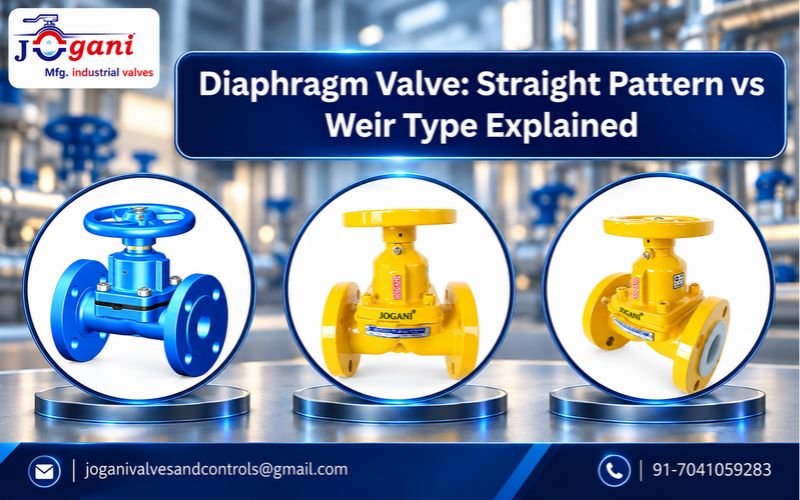
Choosing between diaphragm valve designs is not only a catalogue decision. The internal flow path affects pressure drop, solids handling, throttling, diaphragm movement and maintenance. For process engineers and purchase teams, the real question is how the valve will behave with the actual media.This is where the Weir Type vs Straight-Through Diaphragm Valve comparison becomes important. A chemical line, slurry pipeline, water-treatment system and hygienic process may all need different priorities.Before buying, check fluid characteristics, operating pressure, temperature, required flow rate and diaphragm compatibility. The right design can reduce operating problems, simplify maintenance and improve service life over time.
A Weir Type Diaphragm Valve has a raised saddle inside the body. During closing, the diaphragm moves onto this weir and isolates the flow. Its shorter diaphragm travel can support controlled shut-off and throttling.A Straight Pattern Diaphragm Valve uses a more direct passage with less obstruction. As a result, it generally provides lower flow resistance and can handle viscous media or suspended solids more comfortably.In simple words, one design controls flow over a raised seat, while the other keeps the passage more open.
A Weir Type Diaphragm Valve uses a raised weir inside the valve body. Because of this design, the fluid changes direction slightly while passing through the valve.A Straight-Through Diaphragm Valve provides a more direct passage. Therefore, fluid can move through the valve with less obstruction.When it comes to pressure drop, the weir type can create slightly more resistance because of the raised seat. On the other hand, straight-through designs usually offer lower pressure loss.Another difference is diaphragm movement. A weir type valve usually requires shorter diaphragm travel, while a straight-through valve needs greater diaphragm movement to achieve full closure.
A weir design is commonly considered when tight shut-off, corrosion resistance and controlled flow matter. Chemical processing, water treatment, dosing systems and process lines can benefit from this arrangement.Because the diaphragm closes against a raised weir, it does not need to flex as deeply. Therefore, the design can suit repeated operation when the diaphragm material matches the media.For corrosive service, buyers may also consider compatible lined bodies and diaphragms. Most importantly, check concentration and temperature, not only the fluid name.
Straight-through construction helps when the process needs a freer passage. Slurries, pulp, mining fluids, wastewater and viscous products may contain solids that do not move easily across a raised obstruction.For this reason, a Straight Pattern Diaphragm Valve is often evaluated where lower flow restriction and solids handling are priorities.On the other hand, the diaphragm may need greater movement to close the valve. Buyers should therefore review diaphragm quality, cycling frequency, pressure and temperature before selection.
Valve geometry is only one part of reliable selection. Body, lining and diaphragm materials must suit the actual process.Depending on the application, buyers may evaluate cast or ductile iron, stainless steel, rubber-lined bodies or fluoropolymer-lined options. Diaphragm choices may include suitable elastomers or PTFE-faced constructions.For example, a valve that performs well in water may not suit an aggressive acid. Always match materials to the fluid, concentration, temperature, pressure and cleaning conditions.
A complete RFQ helps a manufacturer recommend the correct Diaphragm Valve Types without guesswork. Share the service fluid, concentration, pressure, operating temperature, line size and end connection.Along with this, mention manual or pneumatic actuation, body material, lining preference, diaphragm material, quantity and dimensional limits.For bulk orders, ask for technical data and applicable testing information before approval. In many cases, this prevents incorrect selection and keeps specifications consistent across the project.
Local technical support is useful when a valve must match an existing pipeline or special process condition. Jogani Valves And Controls, based in Ahmedabad, Gujarat, supports industrial buyers with flow-control requirements.Whether purchasing in Gujarat or elsewhere in India, compare technical suitability before price alone. Also review lead time, repeat supply and documentation.At the same time, provide complete operating data. Clear application details help the manufacturer suggest a more suitable configuration.
The right choice in the Weir Type vs Straight-Through Diaphragm Valve comparison depends on media and operating duty. Weir designs suit controlled shut-off and many process services. Straight-through designs often help where low restriction and solids handling matter.Before ordering, confirm material compatibility, pressure, temperature, size and actuation. For product details, size selection, quotation or bulk requirements, contact Jogani Valves And Controls for application-based support.
A straight-through style usually has an open path and less resistance.
A straight-through style is usually better for materials or materials with particles depending on the situation.
Yes if the body, lining and diaphragm materials are right for the chemical its strength and the temperature.
Yes. The raised part can help control the flow, in process applications.
Give the material used the strength, the pressure, the temperature, the size, the connection type, the material choices the way it will be operated and the quantity.
A straight-through style usually has an open path and less resistance.A straight-through style is usually better for materials or materials with particles depending on the situation.Yes if the body, lining and diaphragm materials are right for the chemical its strength and the temperature.Yes. The raised part can help control the flow, in process applications.Give the material used the strength, the pressure, the temperature, the size, the connection type, the material choices the way it will be operated and the quantity.