AN ISO 9001:2015 CERTIFIED COMPANY
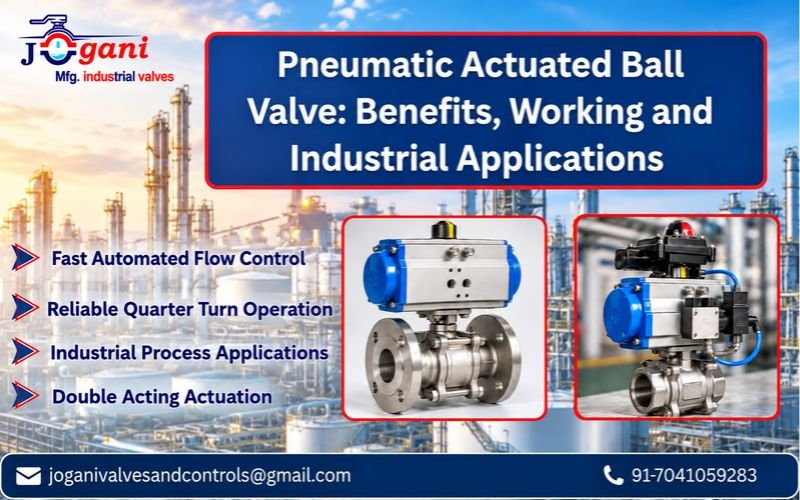
Industrial pipelines often need fast, dependable and repeatable flow shut-off. Manual valves can work well for simple lines, but frequent operation creates labor, timing and safety challenges. A pneumatic actuated ball valve combines a quarter-turn ball valve with a compressed-air actuator. The result is quick automatic operation with easy integration into plant control systems.For engineers and procurement teams, the key is matching the valve body, seat, actuator and accessories to the process. This guide explains how the system works, where it fits, and what buyers should check before ordering from a valve manufacturer in Ahmedabad or elsewhere in India.
A pneumatic ball valve uses air pressure to rotate the valve stem and move the ball between open and closed positions. Because the ball normally turns through 90 degrees, it can respond quickly during repeated cycles.A pneumatic operated ball valve is useful where operators need remote control. It can connect with solenoid valves, limit switches, positioners and PLC-based automation. Therefore, plants can coordinate flow control with other equipment instead of relying on manual access.
The valve body controls the process media, while the pneumatic actuator supplies movement. Compressed air enters the actuator and turns its shaft, which rotates the ball inside the valve.The actuator may be single acting or double acting. A single-acting setup uses air for one direction and a spring for the return stroke. A double-acting actuator uses air for both opening and closing.This difference matters during specification. Engineers should consider the required fail position, operating cycle and available air supply before selecting an air actuated ball valve.
Valve material should follow the media, pressure and temperature rather than the lowest purchase price. Common industrial configurations use carbon steel, stainless steel and other suitable alloys. Seat selection also matters because PTFE, reinforced PTFE and high-performance materials suit different service conditions.Also confirm valve size, pressure class, end connection, bore design and actuator torque. A pneumatic actuator ball valve needs sufficient torque for reliable movement under actual operating conditions.
First, pneumatic actuation enables fast quarter-turn operation. Next, remote switching can reduce the need for operators to approach difficult areas. Moreover, automated cycling can improve consistency in repetitive processes.Compressed air is available in many industrial facilities. As a result, pneumatic systems can fit existing automation infrastructure.However, the actuator cannot compensate for a poorly selected valve body or seal. A reliable assembly needs proper matching across the system, including actuator sizing, air quality, mounting and process compatibility.
An industrial pneumatic ball valve is commonly selected for frequent on-off isolation or automated flow routing. Typical sectors include chemical processing, water treatment, pharmaceuticals, food and beverage, utilities, engineering plants and process manufacturing.These valves can control water, air, gases, compatible chemicals and other process fluids, depending on materials and design. In many cases, buyers use them on transfer lines, utility systems, dosing arrangements and automated production equipment.For high-temperature, corrosive or special-fluid service, the configuration needs closer review. Material compatibility, seat limits and pressure-temperature conditions should be checked before approval.
Confirm pipeline size and end connection first. Then provide media, operating pressure, operating temperature and flow direction. Next, specify body and seat material, actuator type and fail position.Also ask about actuator torque, air pressure requirements, mounting standard, solenoid valve arrangement and feedback options. For bulk purchases, consistency matters as much as unit price. Matching specifications across supplied valves can simplify installation, spares planning and maintenance.
A valve can meet a datasheet and still create problems if manufacturing control is inconsistent. Dimensional accuracy, sealing surfaces, assembly quality and testing all affect field performance.Jogani Valves and Controls states that it operates from Ahmedabad and is ISO 9001:2015 certified. The company also describes engineering, testing and after-sales support as part of its service approach.For Gujarat-based buyers, local technical communication can simplify specification discussions, inspection coordination and replacement requirements. Most importantly, select a supplier that reviews the application instead of supplying a generic automatic ball valve.
A pneumatic actuated ball valve can bring faster operation, remote control and repeatable shut-off to an industrial pipeline. However, dependable performance starts with correct selection. Valve material, seat design, actuator torque, air supply and process conditions should work together.For projects in Ahmedabad, Gujarat or across India, buyers can share line size, media, pressure, temperature and connection details with Jogani Valves and Controls for product guidance, technical details or a bulk quotation.
Yes, it is commonly used where automated on-off cycling is required, provided the valve and actuator are correctly sized.
Single-acting actuators use a spring for one stroke. Double-acting actuators use compressed air for both directions.
Choose body and seat materials according to the process media, pressure and temperature. Chemical compatibility is essential.
Yes. With suitable solenoid valves, switches or position feedback, pneumatic assemblies can integrate with PLC and plant automation systems.
Share line size, media, pressure, temperature, end connection, material, actuator type and control or feedback requirements.
Yes, it is commonly used where automated on-off cycling is required, provided the valve and actuator are correctly sized.Single-acting actuators use a spring for one stroke. Double-acting actuators use compressed air for both directions.Choose body and seat materials according to the process media, pressure and temperature. Chemical compatibility is essential.Yes. With suitable solenoid valves, switches or position feedback, pneumatic assemblies can integrate with PLC and plant automation systems.Share line size, media, pressure, temperature, end connection, material, actuator type and control or feedback requirements.