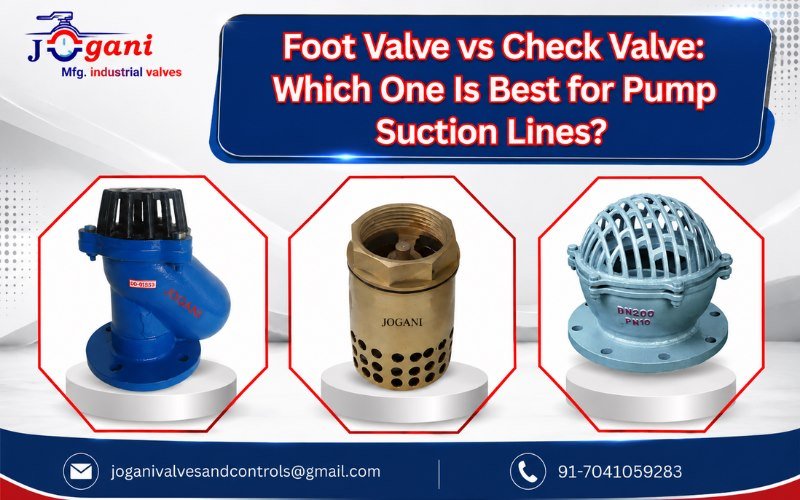
Foot Valve vs Check Valve: Key Differences for Pump Suction Lines
Choosing the right valve for a pump suction line can directly affect priming, starting performance, maintenance, and flow losses. That is why many buyers compare a foot valve vs check valve before finalising a pumping system. Both valves control reverse flow, but their installation purpose and application can differ.
A foot valve is normally fitted at the lower end of a suction pipe. It helps keep the suction line filled when the pump stops. Many designs also include a strainer to reduce the entry of foreign material. A standard check valve, meanwhile, is a broader non-return valve used to stop flow in the reverse direction.
Why the Suction Line Needs the Right Valve
A centrifugal pump operating with suction lift may lose its prime when the pump stops. Once the suction pipe drains, the pump may need to be primed again before restarting.
This is where a foot valve for pump suction becomes useful. Installed near the lower end of the suction pipe, it helps prevent the pipe from emptying. As a result, the pump can restart without repeatedly filling the suction line.
However, suction valves must be selected carefully. Excessive friction or an unsuitable valve can increase suction losses and affect pump performance. Xylem also recommends sizing the foot valve and suction pipe to minimise suction-line losses.
Foot Valve vs Check Valve: What Is the Real Difference?
A standard check valve is designed to allow flow in one direction and automatically stop reverse flow. It can be installed in different sections of a piping system, depending on the application.
A foot valve is essentially a type of check valve used in suction applications. KSB describes a foot valve as a lift check valve commonly installed with a suction strainer. Its main job is to keep the suction line from running empty after pump shutdown.
When a Foot Valve Makes More Sense
The foot valve for water pump applications is also useful where the intake end sits inside a tank, sump, well, or water source. A strainer-equipped design can help reduce the entry of debris into the suction pipe.
However, the valve should not be selected only by pipe diameter. Buyers should consider flow rate, fluid cleanliness, suction conditions, pressure loss, connection type, and installation depth.
When a Check Valve Can Be the Better Choice
A
check valve for pump suction line may be considered when the system requires non-return protection but does not necessarily need the same arrangement as a traditional foot valve.
KSB notes that, for some non-self-priming centrifugal pumps, either a foot valve or a swing check valve can be installed below the lowest water level. At the same time, the selection must account for surge pressure and proper sizing.
So, NRV vs foot valve is not just a product comparison. It is a system-design decision.
A Practical Product Reference: Kirloskar Foot Valve
The Kirloskar Foot Valve is designed for installation on the suction side of pumps. Kirloskar foot valves prevent reverse flow to the sump and help keep the pump primed. The company lists sizes from 50 mm to 600 mm and states that the valves are designed, manufactured, and tested according to IS:4038.
Kirloskar’s installation manual also describes its swing-type foot valve as a valve generally placed at the lower end of a centrifugal pump suction pipe. The manual notes its particular usefulness where suction lift or vertical pipe height is considerable.
What Engineers and Buyers Should Check Before Ordering
Before selecting a pump suction valve, review the complete pumping arrangement rather than choosing a valve from size alone.
Check the following:
- Pump type and whether it is self-priming
- Suction lift and suction pipe length
- Required flow rate
- Fluid quality and presence of suspended solids
- Valve size and connection standard
- Expected pressure and temperature
- Pressure drop through the valve
- Strainer requirement
- Potential water hammer during shutdown
- Material suitability for the pumped fluid
Most importantly, the valve should support the pump rather than restrict its suction performance.
Why Manufacturing Quality Matters in Suction Applications
Jogani Valves And Controls operates from Ahmedabad, Gujarat, and manufactures and supplies industrial valves, strainers, and related flow-control products. Its website lists both Foot Valve and Check Valve (NRV) among its product categories. The company also describes its valves as being tested against quality requirements.
For Gujarat-based contractors, pump dealers, engineering companies, and industrial buyers, working with a local supplier can also simplify technical discussions, product selection, and routine communication.
So, Which Valve Should You Choose?
If the main requirement is to keep a suction line filled and maintain pump prime, a properly selected foot valve is often the practical choice. When the main requirement is general reverse-flow prevention, a suitable check valve may be more appropriate.
Still, neither valve should be selected in isolation. Pump design, suction losses, installation conditions, fluid characteristics, and shutdown behaviour all matter.
Final Takeaway
The foot valve vs check valve decision becomes much easier when you start with the pump system rather than the valve catalogue. A foot valve is specifically useful for suction-lift arrangements where maintaining prime is important, while a standard check valve offers broader non-return protection.
For product selection, size, material, grade, technical details, quotation, or bulk requirements, buyers can discuss their application with
Jogani Valves And Controls, Ahmedabad and select the valve based on actual operating conditions.
Frequently Asked Questions