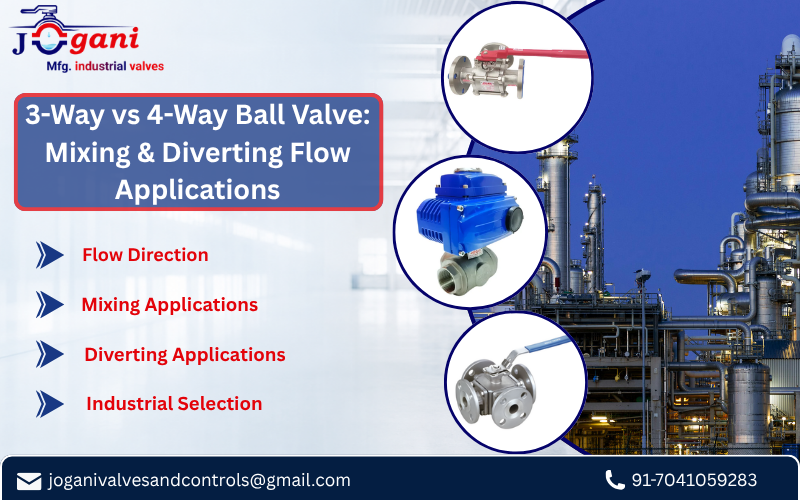
3-Way vs 4-Way Ball Valves: Key Differences
Choosing the right multi-port valve can affect flow stability, maintenance, and piping complexity. The key question is often simple: should you use a 3-way or 4-way ball valve? A clear comparison helps engineers avoid incorrect flow patterns and costly changes after installation.
A
3-way ball valve is commonly selected for diverting, selecting, or mixing flow, while a
4-way ball valve suits more complex routing between four connections. Therefore, buyers should review the required flow path before confirming a specification.
Start with the Flow Problem, Not Just the Valve Size
A 3 way ball valve has three ports and uses an internal bore to connect different flow paths. L-port and T-port configurations are especially important. L-port designs are commonly used to divert or select flow, while T-port designs can support mixing or wider flow distribution.
A
4 way ball valve adds another connection for more complex switching or cross-routing duties. It can help when several process lines need controlled changeover through one valve body. Choose the flow logic first, then confirm size, pressure, temperature, and material.
3-Way Ball Valve vs 4-Way Ball Valve: Where Each One Fits
The difference becomes clearer through practical applications.
A 3-way valve works well when one common line must be directed toward one of two destinations. It can also combine two streams into one outlet when the selected design supports that flow pattern. For example, temperature-control systems may use a T-port arrangement for blending, while changeover lines may use an L-port arrangement for diversion.
A 4-way design is better suited to advanced routing. Typical duties include cross-routing, circuit switching, and process changeover. Because its flow geometry is more complex, buyers should select it from an exact port-position diagram rather than by the valve name alone.
L Port vs T Port Ball Valve: A Critical Buying Decision
An L-port ball has an L-shaped passage and normally connects the common port with one side at a time. This makes it useful for diverting or selecting flow. A T-port ball has a T-shaped passage and can connect multiple ports in specified positions, making it useful for mixing, distribution, or selected routing.
However, the actual flow pattern depends on port numbering and stop arrangement. Ask the manufacturer for the flow-path drawing before purchase.
Materials and Manufacturing Quality Matter in Process Service
Flow-path selection is only one part of reliable valve performance. The body, ball, stem, seats, seals, and end connections must suit the process medium and operating conditions. Stainless steel and carbon steel are common industrial construction choices, but the correct grade depends on pressure, temperature, corrosion, and fluid compatibility.
Jogani Valves And Controls manufactures 3-way ball valves in Ahmedabad with stainless steel and carbon steel options. Its product page also highlights leak-resistant sealing, smooth quarter-turn operation, and low-maintenance construction.
Where Multi-Port Ball Valves Add Real Value
Multi-port ball valves are useful across industrial flow-control systems where routing flexibility matters. Common sectors include chemical and petrochemical plants, oil and gas facilities, power generation, water and wastewater treatment, process skids, and industrial automation.
In addition, a compact multi-port arrangement can reduce the need for several valves and fittings in some layouts. This may simplify installation and access. However, the valve should never be chosen only because it looks compact. Its internal flow logic must match the actual process duty.
A Practical Checklist for Ahmedabad and Gujarat Buyers
Before placing an order, confirm five points: flow pattern, line size, pressure and temperature, process fluid, and actuation requirement. Along with this, request the valve drawing and port-position schedule.
For projects in Ahmedabad and across Gujarat, a local manufacturer can make technical discussions and supply coordination easier. Jogani Valves And Controls is an ISO 9001:2015 certified engineering company based in Ahmedabad and supplies industrial flow-control products for process applications.
Choosing with Confidence
The best valve is not always the valve with more ports. A 3-way valve is often the smarter choice for straightforward mixing, selecting, or diverting duties. A 4-way valve becomes valuable when the process demands advanced routing or switching.
In the end, the right
3-Way Ball Valve vs 4-Way Ball Valve decision should come from the required flow path, operating conditions, and long-term service needs. For sizing, material selection, flow-pattern confirmation, or bulk requirements, contact
Jogani Valves And Controls.
Frequently Asked Questions