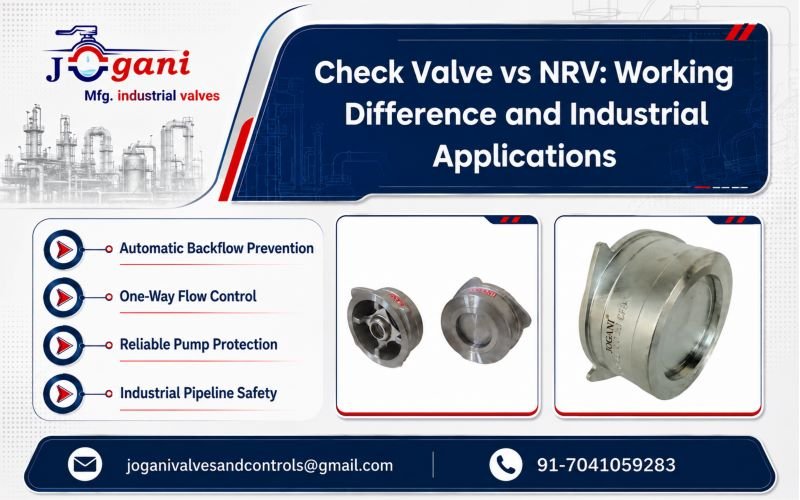
Check Valve vs NRV: Working Principle and Industrial Applications
When buyers compare
Check Valve vs NRV, they often assume they are two different products. In most piping specifications, however, NRV simply means non-return valve, another name for a check valve. Both allow media to move forward and automatically stop reverse flow. The real purchasing decision is not about choosing one name over the other.
It is about selecting the correct design, material, pressure rating and closing response for the system. A poor selection can cause leakage, pressure loss, valve slamming or pump damage. This guide explains the terminology, working method, industrial uses and practical checks that help buyers choose a reliable valve.
Check Valve vs NRV: Is There a Working Difference?
Engineers generally find no functional difference between Check Valve and NRV. Both describe a self-acting valve that permits one-way flow. However, disc, swing, lift, dual-plate and wafer designs respond differently to pressure changes.
Therefore, buyers should compare the construction and duty conditions instead of relying only on the product name.
What Happens Inside the Valve During Operation?
The Check Valve Working Principle depends on pressure difference. Forward pressure pushes the closing element away from its seat and allows flow. When the flow slows, stops or reverses, gravity, a spring or reverse pressure returns the element to its seat.
Engineers call the minimum opening pressure cracking pressure. If it is too high, the valve may restrict flow. If closing is too slow, reverse velocity may cause noise or water hammer. In simple words, the NRV Valve Working Principle is automatic, but correct sizing determines how smoothly it works.
Where a Disc Check Valve Fits Best
A
Disc Check Valve uses a moving disc to open the flow path and seal against reverse movement. Depending on the design, a spring may support faster closing. Its compact construction can suit pipelines where installation space and quick response matter.
For this reason, buyers should confirm the medium, flow rate, pressure, temperature and pipe orientation. Moreover, the body, disc, seat and sealing materials must suit the fluid. Buyers should also review pressure drop because an undersized valve can reduce system efficiency.
Industrial Systems That Depend on Backflow Control
Common Industrial Check Valve Applications include pump discharge lines, water-treatment plants, chemical units, oil and gas pipelines, power plants and HVAC systems.
For example, a Check Valve for Backflow Prevention can stop water returning when a pump shuts down. In chemical service, it can help separate process streams. In addition, power and utility systems use these valves to maintain the intended flow direction.
Quality Details That Matter Before a Bulk Order
Most importantly, purchase teams should assess more than price. Ask the supplier to confirm:
- Valve size, pressure class and end connection
- Body, disc, seat and seal material
- Flow direction and installation orientation
- Cracking pressure and expected pressure drop
- Hydrostatic or leakage testing requirements
- Compatibility with the operating medium and temperature
- Applicable project standards and inspection documents
Where a project specifies API 594 or another standard, confirm the design and testing scope before ordering. In addition, share line conditions with the manufacturer. Clear data reduces specification errors and commissioning delays.
Application Support from an Ahmedabad Manufacturer
Jogani Valves And Controls manufactures and supplies industrial check valves and pipeline flow-control solutions from Ahmedabad, Gujarat. The team can review application details such as size, material, pressure class, connection and operating medium before quotation.
As a result, buyers across Gujarat and India can simplify product selection through direct technical discussion. It also helps ensure that the proposed Disc Check Valve matches the actual service conditions.
Conclusion
The Check Valve vs NRV comparison is mainly about terminology; the real difference lies in valve design and application suitability. Buyers should evaluate flow conditions, material compatibility, cracking pressure, orientation and testing needs before purchase.
For Disc Check Valve details, suitable sizes or bulk quotations, contact
Jogani Valves And Controls with your operating data and project requirements.
Frequently Asked Questions