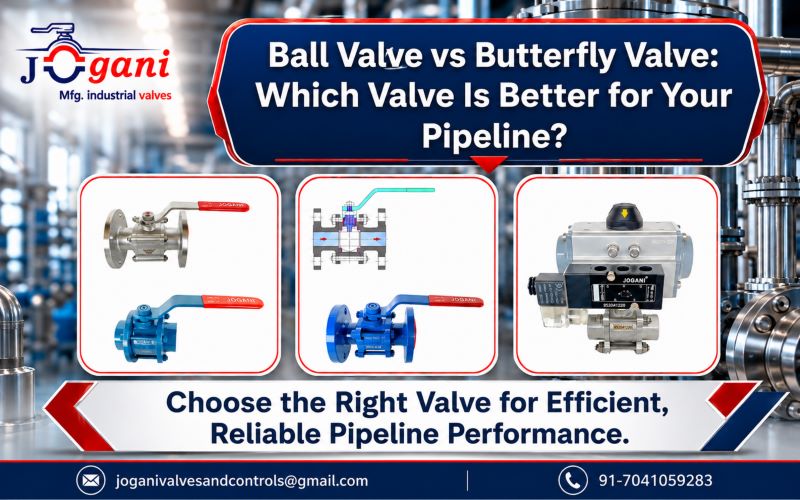
Ball Valve or Butterfly Valve: Which Is Better?
Choosing the right valve affects flow efficiency, shutdown safety, maintenance time and operating cost. Still, many buyers compare only size and price. The
Ball Valve vs Butterfly Valve decision should begin with the fluid, pressure, temperature, pipe diameter and required duty.
A valve suitable for water may not perform well with chemicals, gas or abrasive media. Ball valves generally provide reliable isolation and a clear flow path. Butterfly valves offer compact installation for larger pipelines and general flow regulation. This guide helps industrial buyers and engineers choose the best valve for an industrial pipeline.
Ball Valve vs Butterfly Valve: Begin With Pipeline Duty
Both valves use quarter-turn operation, but they manage flow differently. A ball valve rotates a bored ball inside its body. When fully open, a full-bore design creates an almost straight flow path with little restriction.
A
butterfly valve rotates a circular disc inside the pipe. The disc remains in the media path, even when open. Therefore, first decide whether the valve must provide tight isolation, frequent cycling or flow regulation.
Sealing, Pressure Drop and Flow Control
For dependable on-off service, a ball valve is often the stronger option. Its seat surrounds the ball and supports tight shut-off when materials match the fluid and temperature.
In addition, a full-port ball valve creates little restriction, so pressure drop remains low. However, standard ball valves are not ideal for continuous throttling without control-specific trim. Special control ball valves use designed flow characteristics for regulation.
A butterfly valve creates some resistance because its disc and shaft stay in the flow path. On the other hand, it handles high flow in a compact body and suits general throttling. Precise control still requires correct sizing and an application-specific design.
When Pipeline Size Changes the Cost Decision
Butterfly valves become attractive as pipe diameter increases. Their compact body can simplify handling and installation. In many cases, butterfly valves also cost less than other control valve styles in larger sizes.
Compared with compact wafer-style butterfly valves, ball valves may require more installation space. Nevertheless, they can provide tighter isolation and lower open-valve pressure loss. Buyers should compare lifecycle value rather than only the initial Ball Valve vs Butterfly Valve cost.
Maintenance Access and 3 PC Ball Valve Value
Maintenance planning matters when shutdown time is expensive. Jogani Valves And Controls designs its
3 PC Design Ball Valve so technicians can remove the center body without removing the complete valve from the pipeline. As a result, inspection and servicing become easier.
Butterfly valves use a comparatively simple and compact construction. However, buyers should monitor the disc, liner, seat and actuator movement. Deposits, corrosion or seat wear can increase operating torque and reduce sealing performance.
What Buyers Should Confirm Before Ordering
Before choosing a ball valve or butterfly valve, confirm the media, pipe size, pressure, temperature and flow rate. Along with this, check solids content, corrosion risk, shut-off requirement, cycle frequency and actuator type. Proper valve sizing also requires process pressure, fluid properties and physical pipeline details.
Each wetted material must suit the service. Most importantly, request the correct pressure class, end connection, bore design and test documentation before approving a bulk order.
Industrial buyers in Ahmedabad and across Gujarat may also benefit from local technical guidance.
Jogani Valves And Controls offers full-bore and reduced-bore
3 PC ball valve options, multiple material choices, and
flanged or butt-weld ends. The company operates as an industrial valve manufacturer in Ahmedabad, Gujarat.
Conclusion
There is no single winner in the Ball Valve vs Butterfly Valve comparison. Choose a ball valve for tight isolation, low pressure drop and serviceable construction. Select a butterfly valve when large pipe size, compact installation and general flow regulation matter more.
Frequently Asked Questions